
Apex
Reflex
Apex Reflex
Apex Reflex
Role
Product, UX & Interaction Design
Timeline
Design Sprint
Platform
Mobile First
A mobile reflex-training game inspired by Formula 1 race starts and professional driver reaction drills.
A mobile reflex-training game inspired by Formula 1 race starts and professional driver reaction drills.

PROBLEM & OPPURTUNITY
PROBLEM & OPPURTUNITY
Formula 1 is built around speed, precision, pressure & split-second decision-making.
However, most F1 fan experiences are passive watching races, interviews, highlights, driver content, or race analysis. The opportunity was especially relevant during off-week gaps in the race calendar, when fan engagement often drops.
However, most F1 fan experiences are passive watching races, interviews, highlights, driver content, or race analysis. The opportunity was especially relevant during off-week gaps in the race calendar, when fan engagement often drops.
Challenge
The challenge was to explore how fans could move from simply watching the sport to actively feeling a small part of its physical and mental demand.
Challenge
The challenge was to explore how fans could move from simply watching the sport to actively feeling a small part of its physical and mental demand.
Goal
Create a short, engaging mobile game that translates the physical and mental demands of Formula 1 into an accessible reflex-based experience.
Goal
Create a short, engaging mobile game that translates the physical and mental demands of Formula 1 into an accessible reflex-based experience.
RESEARCH & DISCOVERY
RESEARCH & DISCOVERY
The early research focused on understanding two things: how fans interact with Formula 1 content, and what physical skills are associated with high-performance racing.
A key insight was that Formula 1 fandom is emotionally intense but mostly observational. Fans understand the stakes of race starts, overtakes, pit stops, and reaction battles, but their interaction with these moments is usually limited to watching or discussing them.
The early research focused on understanding two things: how fans interact with Formula 1 content, and what physical skills are associated with high-performance racing.
A key insight was that Formula 1 fandom is emotionally intense but mostly observational. Fans understand the stakes of race starts, overtakes, pit stops, and reaction battles, but their interaction with these moments is usually limited to watching or discussing them.
This led to the idea of designing an experience that could simulate one specific aspect of the sport: Reaction Pressure.
This led to the idea of designing an experience that could simulate one specific aspect of the sport: Reaction Pressure.
This led to the idea of designing an experience that could simulate one specific aspect of the sport: Reaction Pressure.

DESFINING THE USER
DESFINING THE USER
The Casual Enthusiast
This user enjoys Formula 1 and understands the excitement of the sport, but does not want a complex racing simulator or a high-learning-curve game.
The Casual Enthusiast
This user enjoys Formula 1 and understands the excitement of the sport, but does not want a complex racing simulator or a high-learning-curve game.
The Casual Enthusiast
This user enjoys Formula 1 and understands the excitement of the sport, but does not want a complex racing simulator or a high-learning-curve game.
Immediate feedback
Low barrier to entry
Short gameplay sessions
Clear performance results
Reason to replay
IDEATION
IDEATION
The phrase “Lights out and away we go” helped frame the emotional tone of the game.
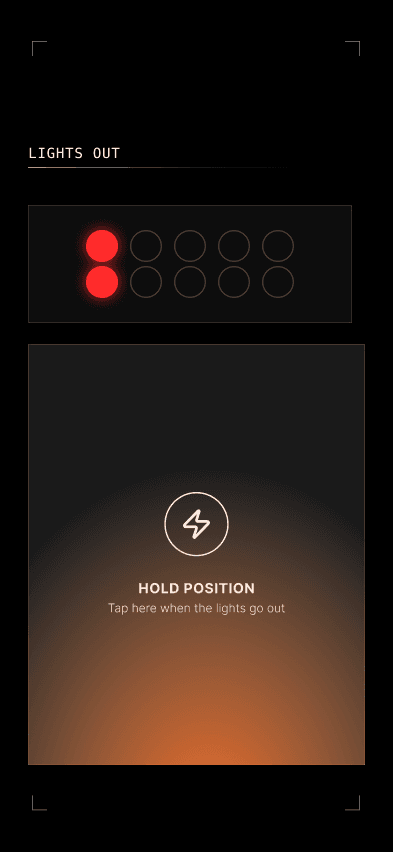
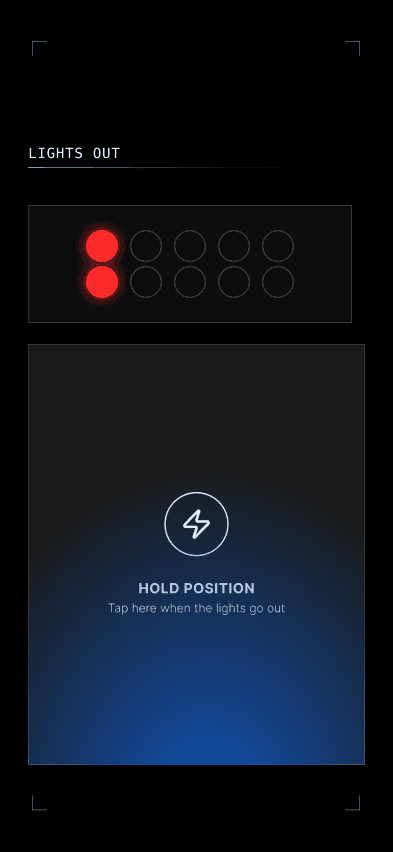
The concept began with the iconic Formula 1 race start: five red lights, rising anticipation, and the moment they go out.
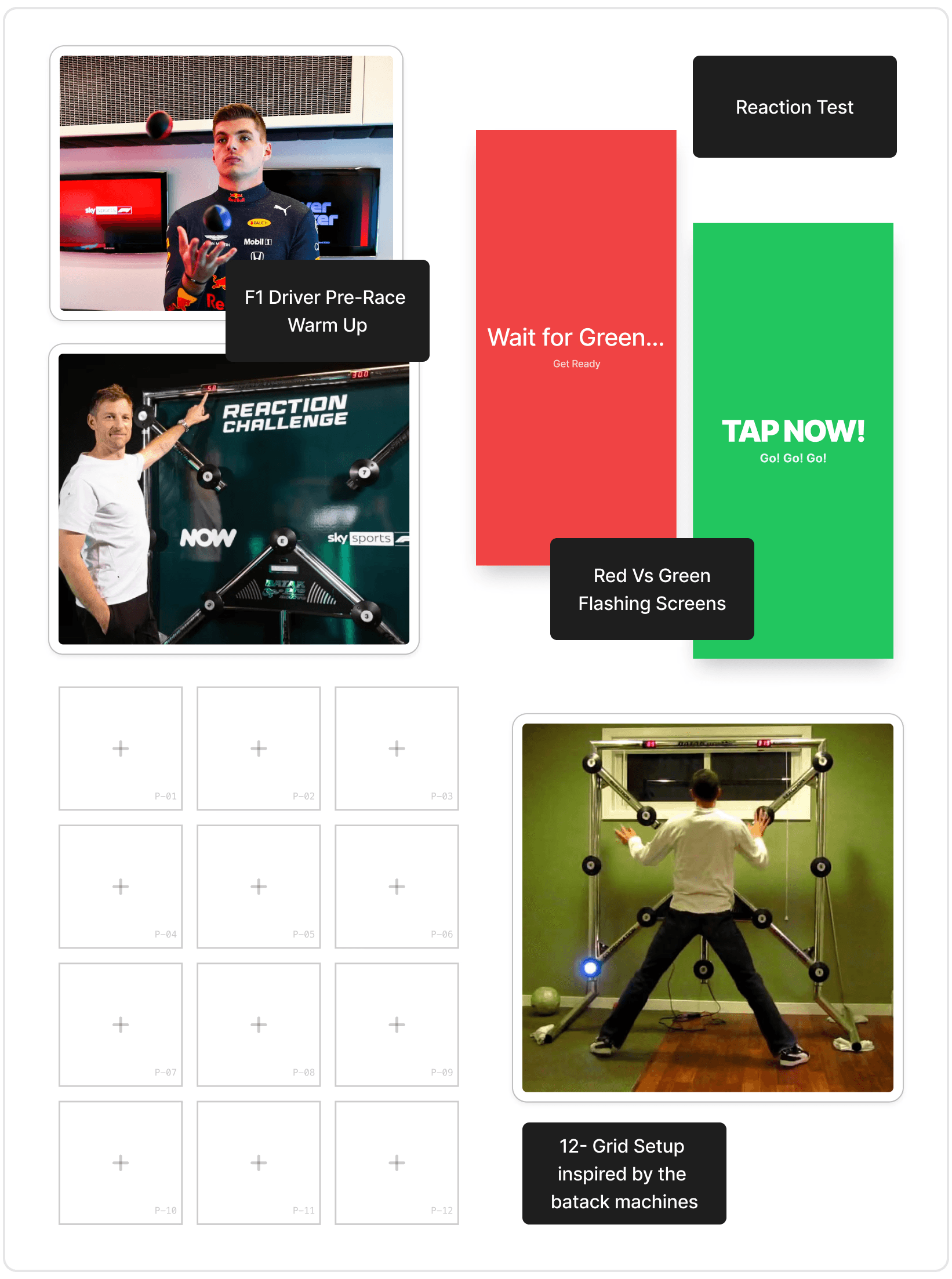
The second major inspiration came from Batak training machines used by racing drivers to sharpen reaction time, peripheral vision, and hand-eye coordination. Apex Reflex translates this physical, spatial training exercise into a tactile mobile experience.
The Batak reference also inspired the game’s grid-based interface. Instead of placing targets randomly without structure, the screen was divided into a 12-zone grid system, creating a digital version of a reflex training board that works naturally on a mobile screen.
The concept began with the iconic Formula 1 race start: five red lights, rising anticipation, and the moment they go out.
The second major inspiration came from Batak training machines used by racing drivers to sharpen reaction time, peripheral vision, and hand-eye coordination. Apex Reflex translates this physical, spatial training exercise into a tactile mobile experience.
The Batak reference also inspired the game’s grid-based interface. Instead of placing targets randomly without structure, the screen was divided into a 12-zone grid system, creating a digital version of a reflex training board that works naturally on a mobile screen.

KEY IDEATION DIRECTIONS
KEY IDEATION DIRECTIONS

F1 Start Lights
Used to create anticipation, tension, and a high-pressure entry moment.
F1 Start Lights
Used to create anticipation, tension, and a high-pressure entry moment.
F1 Start Lights
Used to create anticipation, tension, and a high-pressure entry moment.
Red vs Green Tap
Used to create simple decision-making: tap the correct targets, avoid the wrong ones.
Red vs Green Tap
Used to create simple decision-making: tap the correct targets, avoid the wrong ones.
Red vs Green Tap
Used to create simple decision-making: tap the correct targets, avoid the wrong ones.
Batak-Inspired Reflex Arena
Used to translate physical driver training into a mobile tapping interaction.
Batak-Inspired Reflex Arena
Used to translate physical driver training into a mobile tapping interaction.
Batak-Inspired Reflex Arena
Used to translate physical driver training into a mobile tapping interaction.
12-Grid Interface
Used to structure the screen and create predictable, scalable target placement across difficulty levels.
12-Grid Interface
Used to structure the screen and create predictable, scalable target placement across difficulty levels.
12-Grid Interface
Used to structure the screen and create predictable, scalable target placement across difficulty levels.
GAME FLOW
GAME FLOW
Anticipation, Reaction, & Execution
Rather than dropping players directly into the action, the experience unfolds in three stages that gradually build pressure and reward precision.
Anticipation, Reaction, & Execution
Rather than dropping players directly into the action, the experience unfolds in three stages that gradually build pressure and reward precision.
Anticipation, Reaction, & Execution
Rather than dropping players directly into the action, the experience unfolds in three stages that gradually build pressure and reward precision.
Choose Difficulty
Nail the Race Start
Survive the Reflex Arena
Earn Your Score
GAMEPLAY
GAMEPLAY
Logic & Variables
Logic & Variables
Apex Reflex was designed around a simple but engaging gameplay loop that mirrors the emotional rhythm of Formula 1: anticipation, reaction & execution.

Mode & Difficulty Selection
Mode & Difficulty Selection

Race Start & Reflexes
Race Start & Reflexes

Main Game (Reflex Arena)
Main Game (Reflex Arena)

Feedback & Scoring System
Feedback & Scoring System
PROTOTYPE VALIDATION
PROTOTYPE VALIDATION

Early concepts were tested with Formula 1 fans and casual mobile gamers to validate whether the core interaction felt exciting and understandable.
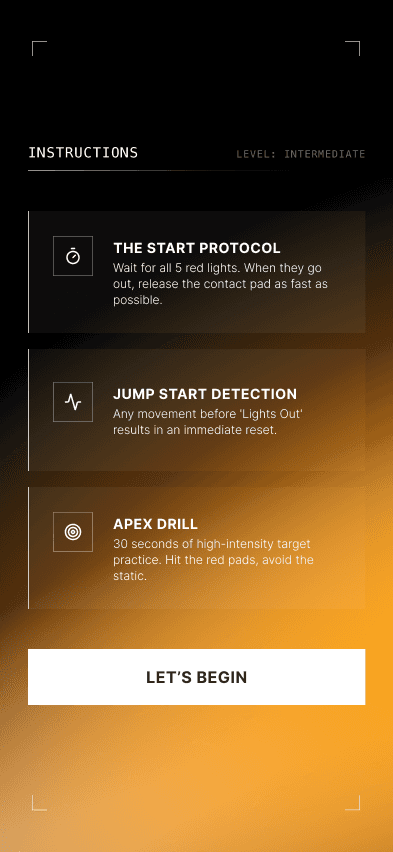
Ease of reading instructions
30% of users skipped or briefly read the instructions, showing the need for clearer visual onboarding.
Ease of reading instructions
30% of users skipped or briefly read the instructions, showing the need for clearer visual onboarding.
Understanding of the jump-start
Reiteration :
30% of users understood the jump-start mechanic only on the second attempt.
Understanding of the jump-start
Reiteration :
30% of users understood the jump-start mechanic only on the second attempt.
Target-tapping gameplay
80% of users enjoyed the target-tapping reflex arena, making it the strongest part of the experience.
Target-tapping gameplay
80% of users enjoyed the target-tapping reflex arena, making it the strongest part of the experience.
Replay motivation & score-chasing
80% of users tried to beat their own score and replayed the game 3–5 times.
Replay motivation & score-chasing
80% of users tried to beat their own score and replayed the game 3–5 times.
MOODBOARD
MOODBOARD


UI DESIGN
UI DESIGN









TRADE OFFS
TRADE OFFS
Realism vs Accessibility
A realistic racing simulator would create friction for casual users.
Realism vs Accessibility
A realistic racing simulator would create friction for casual users.
Randomness vs Fairness
Completely random targets increased difficulty but felt frustrating.
Randomness vs Fairness
Completely random targets increased difficulty but felt frustrating.
Depth vs Simplicity
Focusing on the core loop of the game:
Start → React → Score → Replay.
Depth vs Simplicity
Focusing on the core loop of the game:
Start → React → Score → Replay.