
Severed Sudoku
Severed Sudoku
Reimagining Sudoku through the interaction language of Macrodata Refinement
Role
Product, UX & Interaction Design
PROJECT TYPE
Experimental game concept
Severed Sudoku
Reimagining Sudoku through the interaction language of Macrodata Refinement
Role
Product, UX & Interaction Design
PROJECT TYPE
Experimental game concept
INSIGHT & OPPURTUNITY
INSIGHT & OPPURTUNITY
What if solving Sudoku felt like performing Macrodata Refinement at Lumon?
Severed Sudoku is an experimental game concept inspired by the world of Severance. The project began with a simple connection: both Sudoku and Macrodata Refinement revolve around numbers, patterns, and the feeling that certain combinations somehow “belong” together.
The project became an exercise in creative conceptualisation, interaction design, rapid prototyping, and AI-assisted making.
Severed Sudoku is an experimental game concept inspired by the world of Severance. The project began with a simple connection: both Sudoku and Macrodata Refinement revolve around numbers, patterns, and the feeling that certain combinations somehow “belong” together.
The project became an exercise in creative conceptualisation, interaction design, rapid prototyping, and AI-assisted making.
Insight
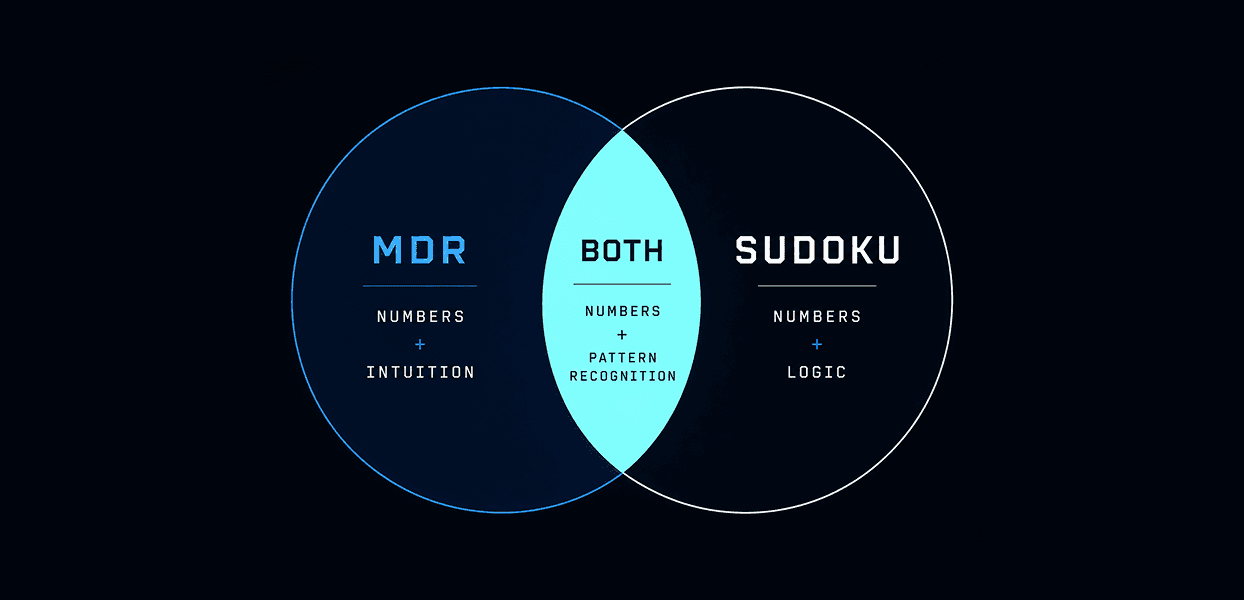
Sudoku and Macrodata Refinement appear unrelated at first, but they share an interesting foundation: numbers, pattern recognition, classification, and completion. In Sudoku, numbers have clear mathematical rules. In Macrodata Refinement, numbers appear abstract and mysterious, but employees are expected to recognise relationships within them and classify them correctly. That overlap created the opportunity.
Insight
Sudoku and Macrodata Refinement appear unrelated at first, but they share an interesting foundation: numbers, pattern recognition, classification, and completion. In Sudoku, numbers have clear mathematical rules. In Macrodata Refinement, numbers appear abstract and mysterious, but employees are expected to recognise relationships within them and classify them correctly. That overlap created the opportunity.
RESEARCH & DISCOVERY
RESEARCH & DISCOVERY
I approached discovery as a study of two existing systems.
On one side was Sudoku—a highly familiar puzzle with established rules, interaction patterns, and expectations.
On the other was Macrodata Refinement—a fictional interface defined less by conventional usability and more by atmosphere, ambiguity, numerical behaviour, procedural work, and unusual feedback.
I approached discovery as a study of two existing systems.
On one side was Sudoku—a highly familiar puzzle with established rules, interaction patterns, and expectations.
On the other was Macrodata Refinement—a fictional interface defined less by conventional usability and more by atmosphere, ambiguity, numerical behaviour, procedural work, and unusual feedback.
Could a familiar logic puzzle become the underlying system for a fictional MDR task?
Could a familiar logic puzzle become the underlying system for a fictional MDR task?
Could a familiar logic puzzle become the underlying system for a fictional MDR task?
DESFINING THE USER
DESFINING THE USER
Designing for both - a player & a fan
The design therefore had to balance usability with intentional mystery. The player should understand how to perform the task even if they never fully understand why the task exists.
The design therefore had to balance usability with intentional mystery. The player should understand how to perform the task even if they never fully understand why the task exists.
The puzzle player needs clarity
The Severance fan needs immersion
CONCEPT
CONCEPT
What would Sudoku look and feel like if Lumon had designed it as an employee task?
That led to a series of conceptual shifts.
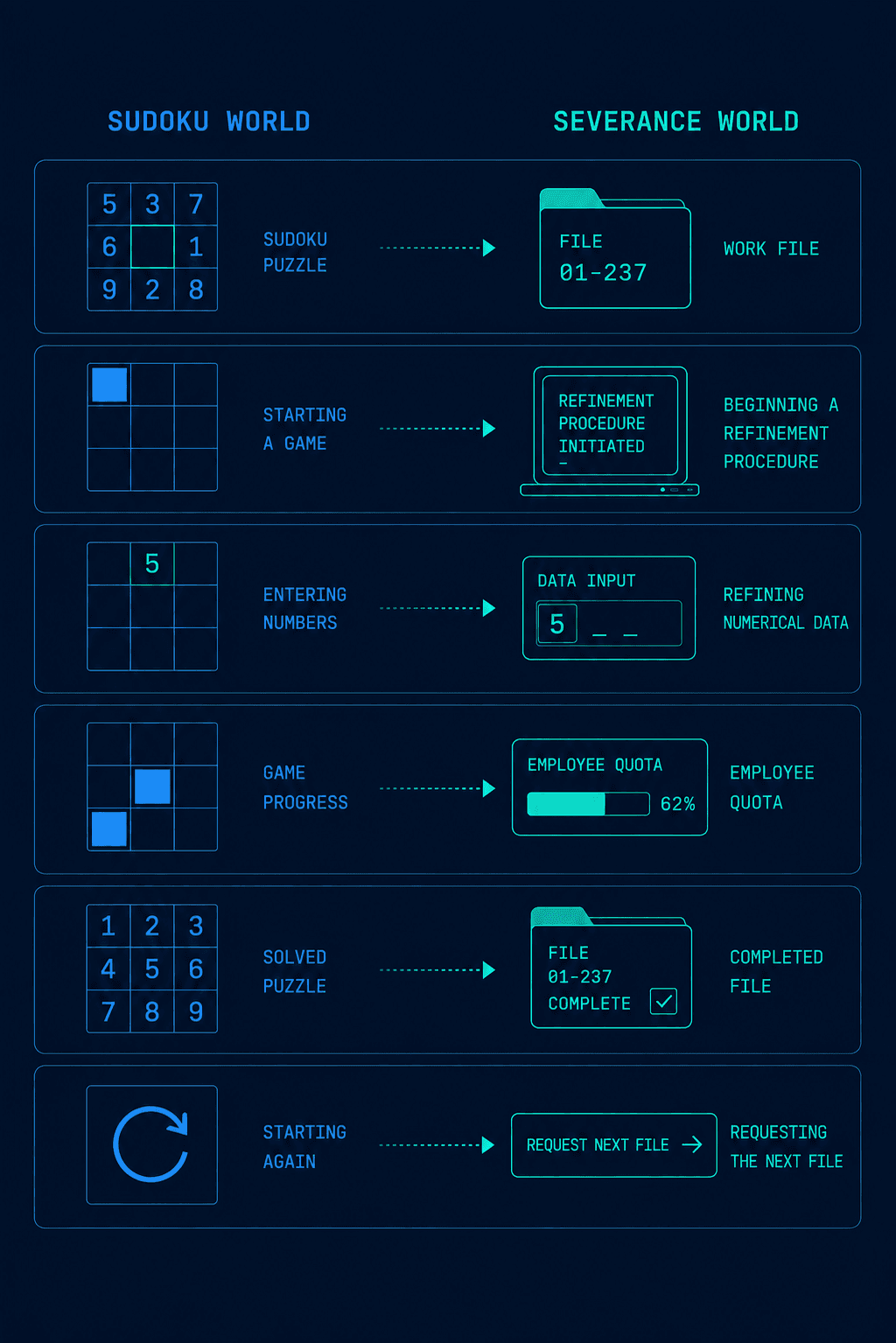
A Sudoku puzzle became a work file.
Starting a game became beginning a refinement procedure.
Entering numbers became refining numerical data.
Game progress became an employee quota.
A solved puzzle became a completed file.
Starting again became requesting the next file.
These changes allowed the core Sudoku rules to remain familiar while the surrounding meaning of the interaction changed completely.
That led to a series of conceptual shifts.
A Sudoku puzzle became a work file.
Starting a game became beginning a refinement procedure.
Entering numbers became refining numerical data.
Game progress became an employee quota.
A solved puzzle became a completed file.
Starting again became requesting the next file.
These changes allowed the core Sudoku rules to remain familiar while the surrounding meaning of the interaction changed completely.

GAME FLOW
GAME FLOW
The Repeatable Refinement Loop
The Repeatable Refinement Loop
The Repeatable Refinement Loop

PROTOTYPE
PROTOTYPE
TRADE OFFS
TRADE OFFS
Fidelity vs Function
Preserving MDR’s atmosphere while adapting the interface to a playable Sudoku.
Fidelity vs Function
Preserving MDR’s atmosphere while adapting the interface to a playable Sudoku.
Efficiency vs Immersion
Accepting a small amount of friction to make number entry feel ceremonial.
Efficiency vs Immersion
Accepting a small amount of friction to make number entry feel ceremonial.
Depth vs Simplicity
Keeping essential controls familiar while leaving room for deeper Lumon styling later.
Depth vs Simplicity
Keeping essential controls familiar while leaving room for deeper Lumon styling later.